
 Türkçe
 English
 Русский
 Français
 Español
 العربية
Drainage
Aspiration Bags
Features
- ADVANTAGES OF THE SYSTEM
- Aspiration bags offer the advantage of protection against possible infections originating from the hospital environment.
- Provides convenience and practical application for the work of users and their teams.
- Connection and assembly are easy.
- Replacement is easy and quick once the bag is full.
- Eliminates the risk of splashing and spills.
- Helps maintain hospital hygiene.
- Provides an advantage in terms of controlled medical waste disposal.
- Because it is a closed system, it prevents odor from spreading to the wards.
- In operating rooms, the anesthesia and surgical teams can easily use it at the same time.
- Can generally be used in similar fluid aspiration procedures that have a vacuum source connection.
- ASPIRATION BAG FEATURES
- Does not come into contact with the patient.
- The bag material and lid system are made of durable plastic.
- Available in 1500, 2000 and 3000 ml capacities.
- The bags are flexible and have a flat base.
- There is an anti-reflux valve at the suction tip of the patient port that prevents backflow.
- There is a special filter at the vacuum suction tip that blocks the passage of bacteria and viruses and stops suction when the bag is full.
- Has a cap system that closes all ports at the end of the procedure.
- A 1.8 m patient tube is available for suctioning from the patient.
- To connect the patient and the bag, there are 2 fittings of suitable standards and 1 finger-controlled Capkon connector (pine-tree connector).
- The aspiration bag has a wide sample port that allows solid specimens, such as bone and tissue samples collected during arthroscopy, endoscopy and similar procedures, to be preserved.
- ADDITIONAL FILLER MATERIALS
- Gelling agent: Gels the fluid taken into the bag, causing it to solidify.
- Anti-foaming agent: Prevents the fluid drawn into the bag from foaming.
- Disinfectant: Disinfects the fluid drawn into the bag. Additives are optional.
Reference
Aspiration Bag 1500 ml
| Code | With hose | Anti-foaming agent | Disinfectant | Gelling agent | Without hose |
|---|---|---|---|---|---|
| 160 202 | ✓ | ||||
| 160 202 1 | ✓ | ||||
| 160 202 2 | ✓ | ||||
| 160 202 3 | ✓ | ||||
| 160 202 4 | ✓ |
Aspiration Bag 2000 ml
| Code | With hose | Anti-foaming agent | Disinfectant | Gelling agent | Without hose |
|---|---|---|---|---|---|
| 160 203 | ✓ | ||||
| 160 203 1 | ✓ | ||||
| 160 203 2 | ✓ | ||||
| 160 203 3 | ✓ | ||||
| 160 203 4 | ✓ |
Aspiration Bag 3000 ml
| Code | With hose | Anti-foaming agent | Disinfectant | Gelling agent | Without hose |
|---|---|---|---|---|---|
| 160 201 | ✓ | ||||
| 160 201 1 | ✓ | ||||
| 160 201 2 | ✓ | ||||
| 160 201 3 | ✓ | ||||
| 160 201 4 | ✓ |
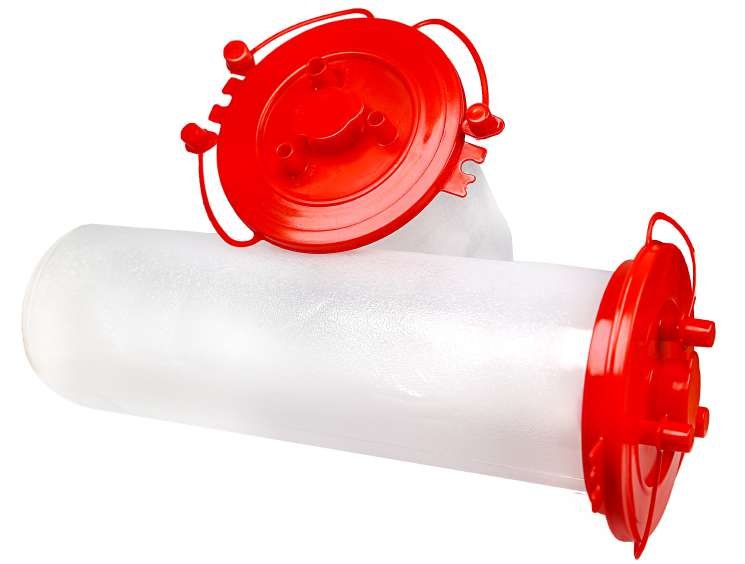
| Description | Code |
|---|---|
| Suction Canister 1500 ml | 160 205 |
| Suction Canister 2000 ml | 160 206 |
| Suction Canister 3000 ml | 160 204 |
Couldn’t find the product you’re looking for?
Contact our team or browse the catalogs for our product range and technical details.